EL2228C
EL2228C is Dual Low Noise Amplifier manufactured by Elantec Semiconductor.
- Part of the EL2 comparator family.
- Part of the EL2 comparator family.
Features
- Voltage noise of only 4.9n V/√Hz
- Current noise of only 1.2p A/√Hz
- Bandwidth (-3d B) of 80MHz @AV = +1
- Gain-of-1 stable
- Just 4.5m A per amplifier
- 8-pin MSOP package
- ±2.5V to ±12V operation
General Description
The EL2228C is a dual, low-noise amplifier, ideally suited to filtering applications in ADSL and HDSLII designs. It feature low noise specification of just 4.9n V/ √ Hz and 1.2p A/ √ Hz, making it ideal for processing low voltage waveforms. The EL2228C has a -3d B bandwidth of 80MHz and is gain-of-1 stable. It also affords minimal power dissipation with a supply current of just 4.5m A per amplifier. The amplifier can be powered from supplies ranging from ±2.5V to ±12V. The EL2228C is available in a space saving 8-Pin MSOP package as well as the industry standard 8-Pin SO. It can operate over the -40°C to +85°C temperature range.
Applications
- -
- -
- - ADSL Filters HDSLII Filters Ultrasound input amplifiers Wideband Instrumentation munications equipment Wideband sensors
Ordering Information
Part No. EL2228CY EL2228CY-T13 EL2228CY-T7 EL2228CS EL2228CS-T13 EL2228CS-T7 Temp. Range 8-Pin MSOP 8-Pin MSOP 8-Pin MSOP 8-Pin SO 8-Pin SO 8-Pin SO Package 13” 7” 13” 7” Outline # MDP0043 MDP0043 MDP0043 MDP0027 MDP0027 MDP0027
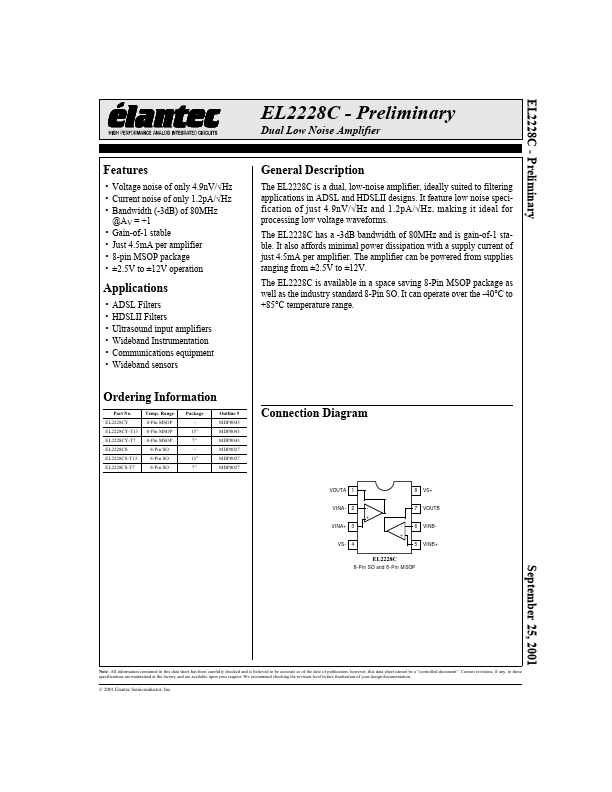
Connection Diagram
VOUTA 1 VINA- 2 VINA+ 3 VS- 4 + +
8 VS+ 7 VOUTB 6 VINB5 VINB+
EL2228C 8-Pin SO and 8-Pin MSOP
September 25, 2001
Note: All information contained in this data sheet has been carefully checked and is believed to be accurate as of the date of publication; however, this data sheet cannot be a “controlled document”. Current revisions, if any, to these specifications are maintained at the factory and are available upon your request. We remend checking the revision level before finalization of your design documentation.
© 2001 Elantec Semiconductor, Inc.
- Preliminary
- Preliminary
Dual Low Noise Amplifier
Absolute Maximum Ratings (T
= 25°C)
Values beyond absolute maximum ratings can cause...